
↩ Retour au chapitre : Limites de fonctions
Voici 7 QCM et 5 vrai/faux sur le chapitre « Limites de fonctions », tous tirés des sujets officiels du Bac de spécialité (2021-2026). La source est indiquée pour chaque question. Chaque réponse est justifiée, y compris, pour les QCM, pourquoi les autres réponses sont fausses.
Comment s’en servir. Cherchez chaque question sans regarder la réponse. Pour les vrai/faux, rédigez votre justification : au Bac, une réponse non justifiée ne rapporte aucun point, et la maîtrise de la langue compte pour 2 points sur 20. Ouvrez ensuite « Réponse et justification » pour comparer.
- Échauffement · les pièges du chapitre (6 vrai/faux interactifs)
- Partie 1 · 7 QCM
- Partie 2 · 5 vrai ou faux
Vrai ou faux ? Les pièges du chapitre
6 affirmations à juger. Au Bac, une réponse non justifiée ne rapporte aucun point : formulez votre justification (une preuve si c’est vrai, un contre-exemple si c’est faux) avant de cliquer.
1. Si f(x) et g(x) tendent toutes deux vers +∞ quand x tend vers +∞, alors f(x) − g(x) tend vers 0.
Faux. Contre-exemple : f(x) = 2x et g(x) = x. Alors f(x) − g(x) = x tend vers +∞. Le piège : « ∞ − ∞ » est une forme indéterminée, tout peut arriver.
2. Si f(x) tend vers 0 quand x tend vers +∞, alors 1/f(x) tend vers +∞.
Faux. Contre-exemple : f(x) = −1/x tend vers 0, mais 1/f(x) = −x tend vers −∞. Le piège : 1/f(x) tend vers +∞ seulement si f(x) tend vers 0 par valeurs positives.
3. Une courbe ne peut pas couper son asymptote horizontale.
Faux. Contre-exemple : f(x) = 2 + sin(x)/x sur ]0 ; +∞[. On a −1/x ≤ sin(x)/x ≤ 1/x, donc f(x) tend vers 2 : la droite y = 2 est asymptote. Pourtant f(kπ) = 2 pour tout entier k ≥ 1 : la courbe coupe son asymptote une infinité de fois.
4. Si f(x) ≤ g(x) pour tout réel x et si f(x) tend vers +∞ en +∞, alors g(x) tend vers +∞ en +∞.
Vrai. C’est le théorème de comparaison. Pour tout réel A, il existe x₀ tel que f(x) > A pour x > x₀ ; on a alors g(x) ≥ f(x) > A. Donc g(x) tend vers +∞.
5. Quand x tend vers +∞, x² − 3x tend vers −∞, car −3x tend vers −∞.
Faux. x² tend vers +∞ et −3x vers −∞ : c’est une forme indéterminée. On factorise par le terme dominant : x² − 3x = x²(1 − 3/x), produit d’un terme qui tend vers +∞ et d’un terme qui tend vers 1. La limite est +∞.
6. Si f(x) tend vers 3 quand x tend vers +∞, alors f(x)² tend vers 9.
Vrai. f(x)² = f(x) × f(x) : d’après les règles sur la limite d’un produit, la limite vaut 3 × 3 = 9.
Votre score :
Pour aller plus loin : les QCM et vrai/faux tirés des vrais sujets du Bac sur ce chapitre, avec une justification détaillée de chaque réponse.
Partie 1 · QCM
Consigne du Bac : pour chaque question, une seule des réponses proposées est exacte. Aucune justification n’est demandée le jour de l’épreuve, mais elle est donnée ici.
QCM 1 · Asie, 8 juin 2021 (jour 2, exercice 1, question 2)
On considère la fonction  définie sur
 par
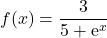 . Sa courbe représentative dans un repère admet :
a. une seule asymptote horizontale
b. une asymptote horizontale et une asymptote verticale
c. deux asymptotes horizontales
Réponse et justification
Réponse c. En  ,
 donc
 : asymptote
 . En
 ,
 donc
 : asymptote
 . La courbe a deux asymptotes horizontales.
Pourquoi pas les autres ?
- a. Il y en a deux : une en
 , une en .
- b. Le dénominateur ne s’annule jamais : pas d’asymptote verticale.
 ne s’annule jamais : pas d’asymptote verticale.
QCM 2 · Centres étrangers (candidats libres), 10 juin 2021 (sujet 2, exercice 1, question 4)
On considère la fonction définie sur par  .
a. 
b. 
c. 
d. On ne peut pas déterminer la limite de la fonction lorsque  tend vers
Réponse et justification
Réponse b. Forme indéterminée «  ». On factorise par
 :
 . Par croissance comparée,
 , la parenthèse tend vers
 et
 .
Pourquoi pas les autres ?
- a. est le coefficient de , pas la limite.
- c. L’exponentielle l’emporte sur .
- d. La forme indéterminée se lève en factorisant.
QCM 3 · Métropole, 11 mai 2022 (sujet 1, exercice 4, question 1)
La courbe représentative de la fonction définie sur par  admet pour asymptote la droite d’équation :
a. 
b. 
c. 
d.
Réponse et justification
Réponse c. Pour  ,
 , qui tend vers
 en comme en : la droite est asymptote.
Pourquoi pas les autres ?
- a. Le dénominateur ne s’annule pas : aucune asymptote verticale.
- b. est le terme constant du numérateur, pas la limite.
- d. Numérateur et dénominateur ont le même degré : la limite est le quotient des coefficients dominants, .
 ne s’annule pas : aucune asymptote verticale.
QCM 4 · Centres étrangers, 12 mai 2022 (sujet 2, exercice 1, question 4)
Que vaut  ?
a. 
b. 
c.
d. n’existe pas
Réponse et justification
Réponse b. On factorise par : 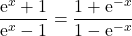 . Comme
 , la limite vaut .
Pourquoi pas les autres ?
- a. C’est la limite en (où ).
- c. Forme indéterminée , qui se lève en factorisant.
- d. La limite existe.
 , qui se lève en factorisant.
QCM 5 · Centres étrangers, 18 mai 2022 (groupe 1, sujet 1, exercice 2, question 3)
On considère la fonction  définie sur l’intervalle
![]1\,;+\infty[](https://missionmaths360.com/wp-content/ql-cache/quicklatex.com-6b0e5c41a95680053f58f55c9916d388_l3.png "Rendered by QuickLaTeX.com") par
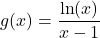 , de courbe
 dans un repère orthogonal. La courbe admet :
a. une asymptote verticale et une asymptote horizontale
b. une asymptote verticale et aucune asymptote horizontale
c. aucune asymptote verticale et une asymptote horizontale
d. aucune asymptote verticale et aucune asymptote horizontale
Réponse et justification
Réponse c. En :  est le taux d’accroissement de
 en , qui tend vers
 . La limite est finie : pas d’asymptote verticale. En :
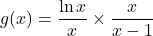 tend vers
 : asymptote horizontale .
Pourquoi pas les autres ?
- a. C’est le piège : le dénominateur s’annule en , mais le numérateur aussi, et la limite vaut .
- b. Il y a bien une asymptote horizontale, .
- d. La limite en est finie.
QCM 6 · Nouvelle-Calédonie, 27 octobre 2022 (jour 2, exercice 4, question 6)
On considère la fonction définie sur l’intervalle ![]0\,;+\infty[](https://missionmaths360.com/wp-content/ql-cache/quicklatex.com-f1ab6641ec00a03740aa826c4edbedf6_l3.png "Rendered by QuickLaTeX.com") par
 , de courbe dans un repère orthogonal. La courbe admet :
a. une asymptote verticale et une asymptote horizontale
b. une asymptote verticale et aucune asymptote horizontale
c. aucune asymptote verticale et une asymptote horizontale
d. aucune asymptote verticale et aucune asymptote horizontale
Réponse et justification
Réponse b. En  par valeurs positives,
 et
 :
 , asymptote verticale
 . En , par croissance comparée,
 : pas d’asymptote horizontale.
Pourquoi pas les autres ?
- a. La limite en est infinie.
- c. En , la limite est infinie.
- d. Il y a une asymptote verticale, .
 , la limite est infinie.
QCM 7 · Centres étrangers, 14 mars 2023 (groupe 1, jour 2, exercice 1, question 3)
On considère la fonction définie sur ![[0\,;+\infty[](https://missionmaths360.com/wp-content/ql-cache/quicklatex.com-8f3c9d115a663adc1a11b54efb9d3cce_l3.png "Rendered by QuickLaTeX.com") par
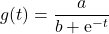 , où
 et
 sont deux nombres réels. On sait que
 et
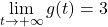 . Les valeurs de et sont :
a.  et

b.  et

c. et 
d.  et

Réponse et justification
Réponse d.  , donc la limite vaut
 :
 . Et
 :
 . D’où
 , et .
Pourquoi pas les autres ?
- a. .
- b. La limite vaut bien , mais .
- c. , mais la limite vaut .
 .
 .
 .
Partie 2 · Vrai ou faux
Consigne du Bac : pour chacune des affirmations, indiquer si elle est vraie ou fausse, en justifiant la réponse. Une réponse non justifiée ne rapporte aucun point.
Vrai ou faux 1 · Amérique du Nord, mai 2021 (exercice A, affirmation 3)
Affirmation : 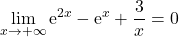 .
Réponse et justification
Faux. Forme indéterminée . On factorise :  , qui tend vers , et
 . La limite vaut .
Vrai ou faux 2 · Amérique du Nord, 18 mai 2022 (jour 1, exercice 4, affirmation 5)
Affirmation :  .
Réponse et justification
Faux.  . Par croissance comparée, : la limite vaut .
Vrai ou faux 3 · Polynésie, 13 mars 2023 (sujet 1, exercice 3, affirmation 3)
Affirmation : 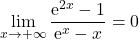 .
Réponse et justification
Faux. On divise numérateur et dénominateur par :  . Le numérateur tend vers , le dénominateur vers : la limite vaut .
Vrai ou faux 4 · Métropole, 19 juin 2024 (sujet 1, exercice 1, affirmation 1)
On considère la fonction définie sur par  , de courbe
 dans un repère orthonormé. Affirmation : l’axe des abscisses est une asymptote horizontale à la courbe .
Réponse et justification
Vrai. 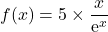 et, par croissance comparée,
 en . Donc : l’axe des abscisses () est asymptote en .
Vrai ou faux 5 · Polynésie, 16 juin 2026 (jour 1, exercice 2, affirmation 1)
Soit la fonction définie sur par  . Affirmation : la limite de la fonction en est .
Réponse et justification
Faux. 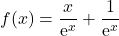 ; les deux termes tendent vers (croissance comparée pour le premier). La limite est . Le piège :
 , mais
 tend vers « plus vite ».
Pour continuer
- L’auto-test du chapitre et les pièges du chapitre
- La fiche d’exercices corrigés
- Les exercices pour élèves motivés
- Les QCM et vrai/faux du Bac des autres chapitres
Énoncés reproduits d’après les sujets officiels du baccalauréat (textes des annales de l’APMEP), parfois légèrement abrégés pour présenter une question isolée. Corrigés : Pr. Elakili.